


 You can try the following project also
 My Project
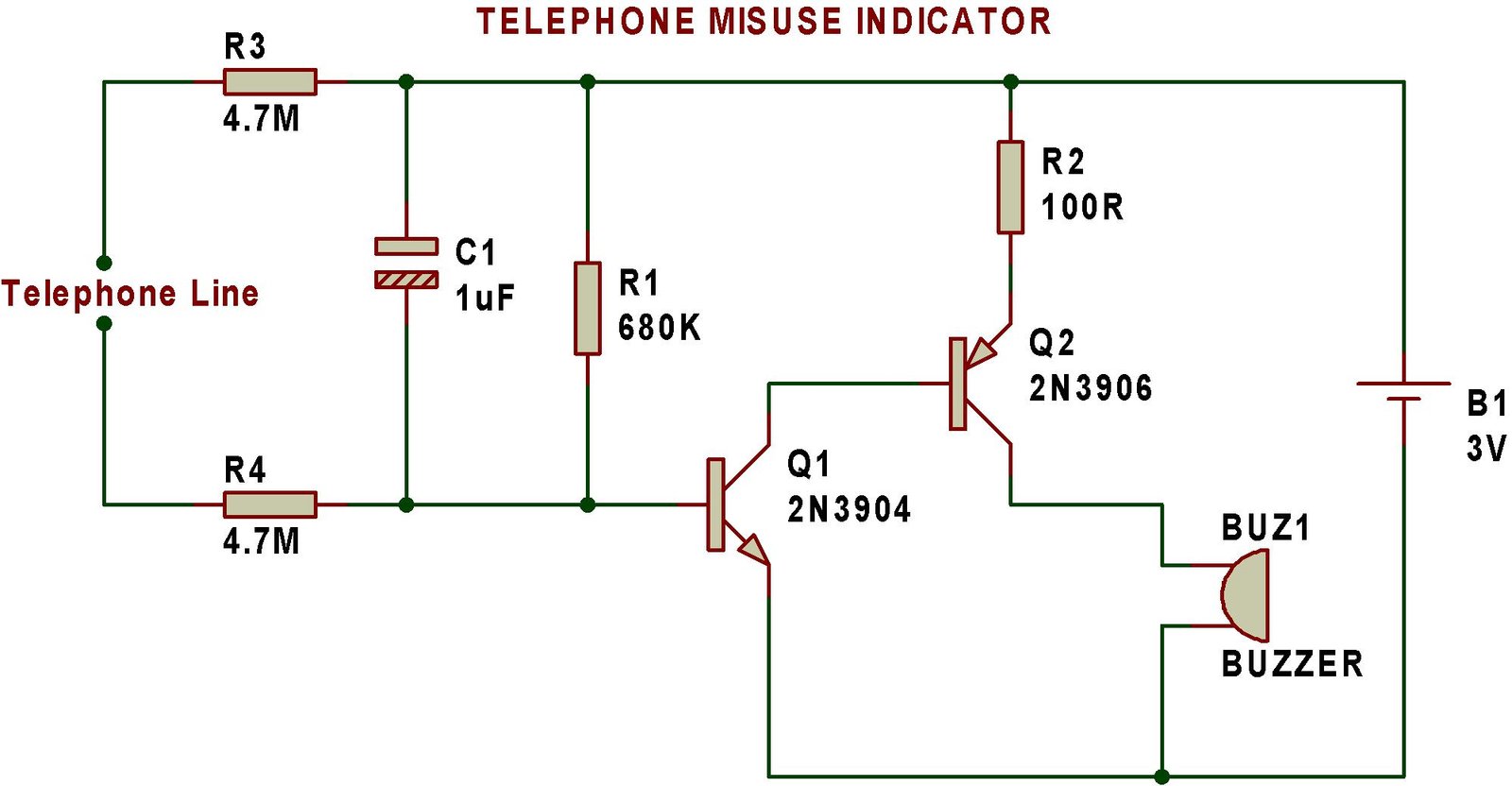

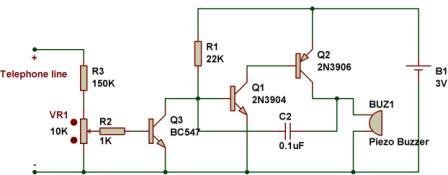
When the phone line is in idle condition (on hook), the full voltage of 48V DC from the exchange appears across the line. When the phone is engaged by lifting the hand set, the voltage across the line falls down to around 12V. Thus, under idle condition (48V), VR1 is adjusted to give a positive biasing voltage to the base of Q3. As Q3 conducts Q1 gets into reverse bias and stops conduction. If the phone is engaged, Q3 stops conducting due to voltage drop across the lines, and subsequently, Q1 and Q2 starts oscillating and beeping is heard. Thus, this circuit can be used as an indicator for telephone tapping and misuse by an unauthorized person.
You can try the following project also
My Project
Explore more circuits, Arduino projects and practical electronics tutorials.
Discover more tutorials →
Explore this hands-on electronics tutorial.
Read tutorial ↗Explore this hands-on electronics tutorial.
Read tutorial ↗Explore this hands-on electronics tutorial.
Read tutorial ↗
Explore this hands-on electronics tutorial.
Read tutorial ↗
Explore this hands-on electronics tutorial.
Read tutorial ↗Explore this hands-on electronics tutorial.
Read tutorial ↗