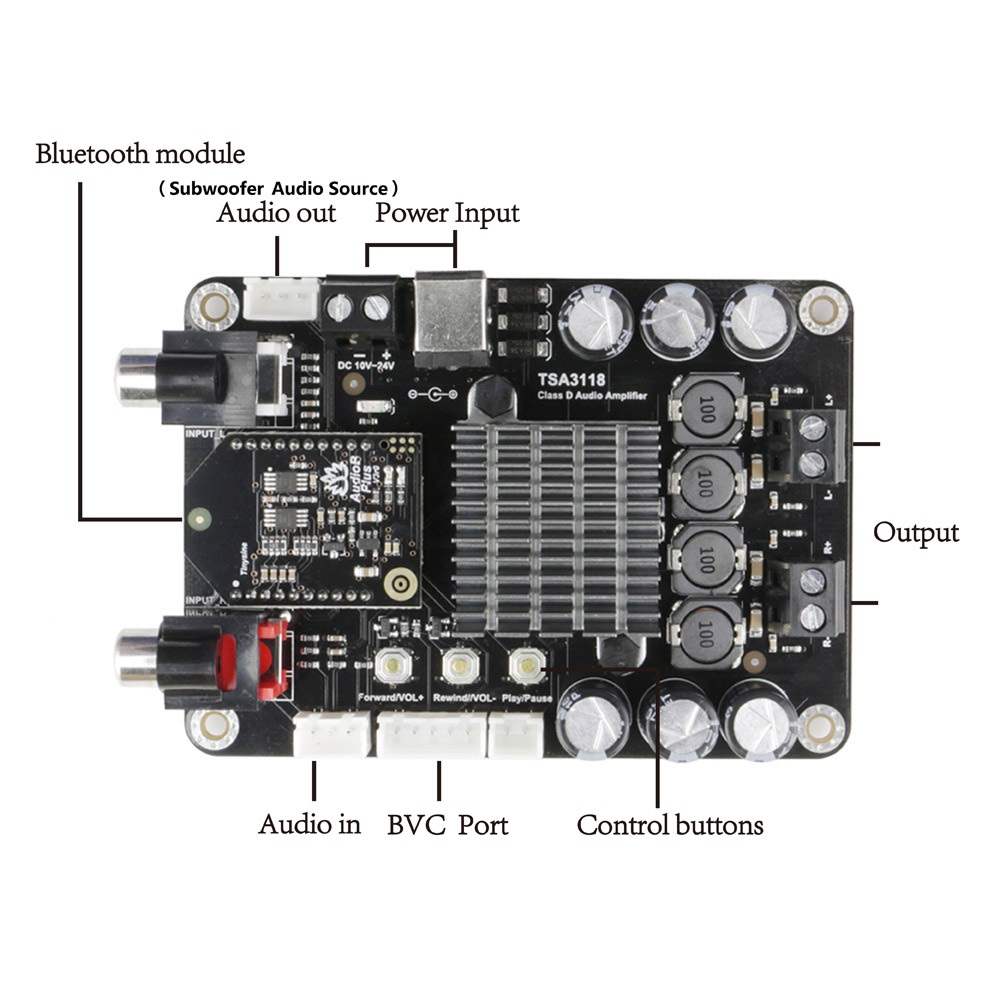
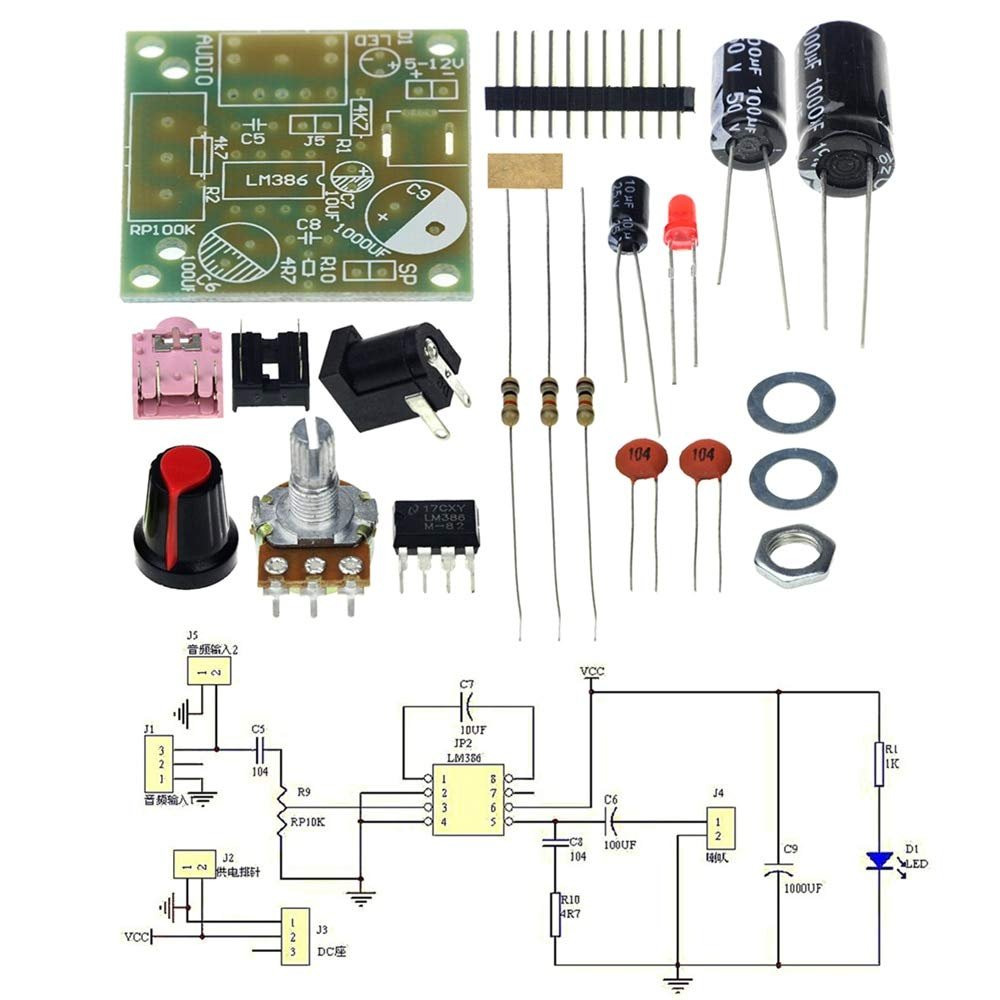
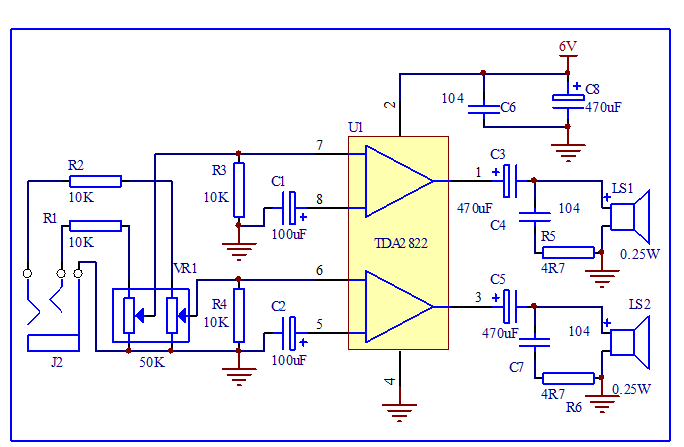
This product does not have Bluetooth feature.
This is a 2x50W audio amplifier that has integrated TI’s TPA3116 as the driver. It has a perfect class-D architecture and each channel has 50W power output. This board can be powered by any DC 12V-24V power supply. It can be used to drive any 4Ω or 8Ω passive speakers. There is an ON/OFF switch and a volume knob on the front panel.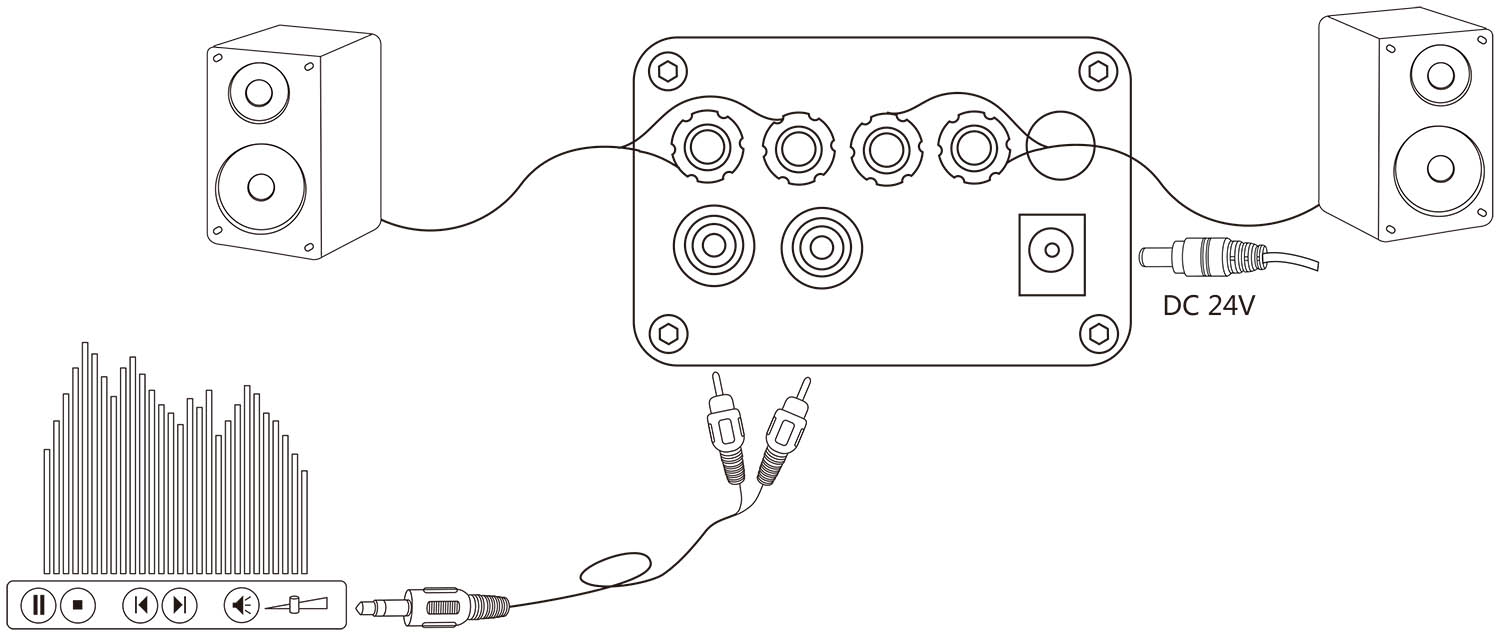 Specification:
TA = 20℃, fIN = 1 kHz sine wave, RL = 4Ω. (Unless otherwise stated)
|
Parameter |
Condition |
Min |
Typ |
Max |
|
Supply Voltage (VDC) |
- |
12 |
21 | 24 |
| Idle Power | SD Floating |
- |
1.3W | 2.5W |
| Standby Power | SD Connected to GND |
- |
0.1W | 0.3W |
| Maximum Current | 100W @ 4Ohm |
- |
5.29A |
- |
| Efficiency | 50W @ 4Ohm | 87% | - | 92% |
| Minimum Load Impedance | 3.2Ω | |||
| Switching Frequency | SD Floating | - | 394KHZ | - |
| Gain | 24dB | 25dB | 26dB | |
| Input Sensitivity(RMS) | @4Ω, 50W, 1KHz | - | 808mV | - |
| Input Impedance | - | - | 22KΩ | - |
| Output Power | @4Ω THD+N 1% | - | 36W | - |
| @4Ω THD+N 10% | - | 50W | - | |
| Bandwidth @ ±3dB | @4Ω | 20Hz | - | 20KHz |
| THD | @4Ω, 1W, 1KHz | - | 0.0299% | - |
| @4Ω, 10W, 1KHz | - | 0.073% | - |
- Dimension: 16cm x 7.5cm x 4.8cm
- Weight: 420g
- Working voltage: DC 12V-24V
- Over-temperature protection
- Overcurrent protection
- Personal computer
- Desktop amplifier
- MP3, Video CD output Amplification
- Home Theater
- Powered DVD Systems